
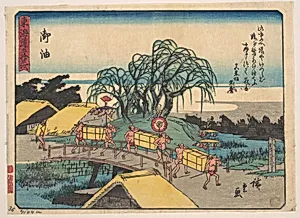
東海道五十三次 御油|Goyu
ca. 1838
Medium
Woodblock print; ink and color on paper
Dimensions
H. 8 7/8 in. (22.5 cm); W. 6 1/2 in. (16.5 cm)
Classification
Prints
Culture & Period
Japan · Edo period (1615–1868)
Department
Asian Art
Museum
Metropolitan Museum of Art, New York, NY
Credit
Rogers Fund, 1921
Accession Number
JP1264
Rights
Public Domain
Tags
Art Historical Context
Utagawa Hiroshige *Goyu*, from his renowned series *The Fifty-three Stations of the Tōidō* (ca. 1838), captures the bustling energy of the 33rd station along Japan's historic Tōkaidō road. Created during the Edo period (16151868), this woodblock print depicts everyday life at Goyu, a vital stopover for travelers journeying between Edo (modern Tokyo) and Kyoto Hiroshige, a master of the ukiyo-e ("pictures of the floating world") tradition, immortalized these roadside scenes, blending landscapes with human activity to evoke the poetry of travel. In this intimate vertical print (8 7/8 x 6 1/2 in.), we see houses nestled among trees, a bridge spanning a stream, and men engaged in working—likely porters or locals tending to the station's demands. Hiroshige's genius lies in his use of vibrant inks and colors on paper, achieved through collaborative woodblock printing. Subtle gradients (bokashi) create atmospheric depth, while dynamic compositions draw the eye through rain-swept paths or misty vistas, hallmarks of his landscape style. As part of the Metropolitan Museum of Art's Asian Art collection (Rogers Fund, 1921), this print highlights ukiyo-e's cultural role in democratizing art for the masses. It offers a window into Edo Japan's mobility and community spirit, reminding us how Hiroshige's works later inspired Impressionists like Monet. A delightful glimpse into a bygone era!
About the Artist
Utagawa Hiroshige · 1826–1869
Utagawa Hiroshige (1797–1858), born Andō Tokutarō, was the last great master of Japanese ukiyo-e woodblock printmaking and one of the most influential landscape artists in history. Born in Edo (modern Tokyo) into a low-ranking samurai family serving as fire wardens, Hiroshige transformed landscape printmaking into a poetic meditation on nature, weather, and everyday life. His revolutionary approac...