
Graflegging
1660 - 1669
Medium
brush
Dimensions
196; 256
Rights
Public Domain
About this artwork
zwart en rood krijt, penseel in bruin en blauw
Art Historical Context
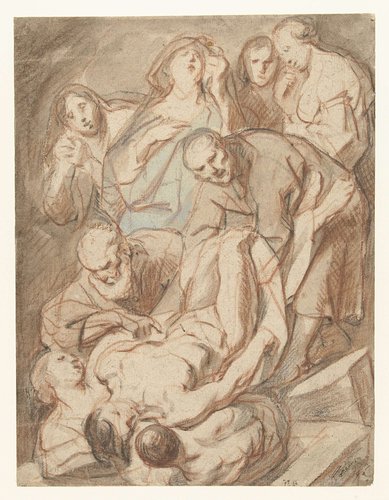
**Graflegging by Jacques Jordaens (1660-1669)** Jacques Jordaens, a leading Flemish Baroque artist (159-1678), created *Graflegging*—Dutch for "Entombmentduring his later career, a period marked by introspective works after the deaths of Rubens and Van Dy. This intimate drawing captures a poignant biblical scene of Christ's body being laid in the tomb, reflecting the emotional depth and dramatic humanism central to Baroque religious art. At just 256 × 196 mm, its modest scale suggests it served as a preparatory study, allowing Jordaens to refine compositions for larger paintings amid Flanders' vibrant Counter-Reformation culture, where such imagery reinforced Catholic devotion. The artwork employs a masterful mixed-media technique: black and red chalk for rich tonal modeling and expressive lines, combined with brushwork in brown and blue for subtle color washes and atmospheric depth. This innovative blend highlights Jordaens' skill in achieving painterly effects on paper, bridging drawing and painting traditions. Red chalk, prized for its warm flesh tones, evokes the pathos of the holy figures, while blue brush adds a veil of mourning sky or shadow. As a window into Jordaens' studio practice, *Graflegging* reveals the meticulous groundwork behind his grand altarpieces, offering visitors a rare glimpse of Baroque creativity in flux—where raw emotion meets technical virtuosity.