
Grand-duc (Eagle Owl)
1895
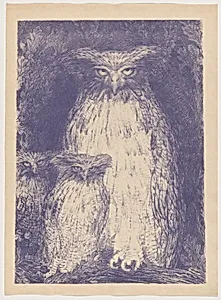
Medium
lithograph in violet on heavy japan paper
Dimensions
image: 34.5 x 25.1 cm (13 9/16 x 9 7/8 in.) sheet: 38 x 27.9 cm (14 15/16 x 11 in.)
Classification
Department
CG-E
Museum
National Gallery of Art, Washington, D.C.
Credit
Virginia and Ira Jackson Collection, gift in memory of Virginia H. Jackson
Accession Number
1996.151.32
Rights
Public Domain
Art Historical Context
Henri de Groux's *Grand-duc (Eagle Owl)*, created in 1895, the majestic presence of Europe's largest owl species through a striking lithograph printed in violet on heavy Japan paper. Measuring 34.5 x 25.1 cm, this print exemplifies the Belgian artist's Symbolist leanings during the fin-de-siècle era, a time when artists like de Groux explored mysticism, nature's enigmas, and emotional depth rapid modernization. Lithography, a 19th-century innovation, allowed de Groux to translate his fluid drawing style directly onto stone, yielding rich tonal variations in a single violet hue that evokes twilight mystery and the owl's nocturnal wisdom. The choice of luxurious Japan paper—prized for its velvety texture and ink absorption—enhances the print's intimacy and durability, reflecting the era's fascination with Eastern craftsmanship amid Europe's Japonisme trend. Housed in the National Gallery of Art's Virginia and Ira Jackson Collection (gift in memory of Virginia H. Jackson), this work highlights de Groux's printmaking prowess within Symbolism, inviting visitors to ponder the owl's gaze as a symbol of introspection and the sublime in nature. A testament to late 19th-century innovation, it bridges fine art and reproductive techniques for wider appreciation.