
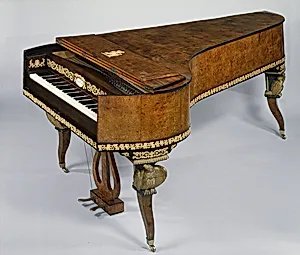
Grand Piano
ca. 1815–20
Medium
Wood, various materials
Dimensions
L. 223.4 cm (88 in.); W. 126.4 cm (49 3/4 in.); Diam. 32 cm (12 1/2 in.); H. 93.7 cm (37 in.); 3-octave span 47.7 cm (18 3/4 in.); Sounding L. (1) f4, 5.5 striking, .5 cm; (2) c2, 27 striking, 3.2 cm; FF,173.2 striking, 16.6 cm
Classification
Chordophone-Zither-struck-piano
Culture
Austrian
Department
Musical Instruments
Museum
Metropolitan Museum of Art, New York, NY
Credit
Purchase, Rogers Fund; Mr. and Mrs. Thatcher M. Brown III, Mr. and Mrs. Philip J. Hess, Carroll Music Instrument Service Corp., The New York Flute Club Inc. and Piano Technicians Guild Gifts; Gifts of Mrs. Etta M. Helmer, Alice Getty, Mr. and Mrs. Henry Wellman, Mr. and Mrs. Peter M. F. Sichel, Craig E. Steese, Hilda Katz, Mr. and Mrs. Arthur A. Travis, and The Crosby Brown Collection of Musical Instruments, by exchange; and funds from various donors, 1982
Accession Number
1982.138
Rights
Public Domain
Art Historical Context
This grand piano, crafted by Austrian maker Joseph Böhm around 1815–20, stands as a fine example of early nineteenth-century Viennese instrument building. During this period, Austria was at the heart of musical innovation, with composers like Beethoven and Schubert pushing the expressive possibilities of the piano. Böhm’s instrument reflects the transition from the lighter fortepiano to the more robust grand piano, embodying the era’s blend of technical precision and elegant design. Classified as a chordophone-zither-struck-piano, the instrument is constructed primarily of wood with various materials, measuring over two meters in length. Its detailed specifications, including sounding lengths for different notes, highlight the careful calibration required to achieve balanced tone across its range. Such pianos were both functional tools for performance and objects of refined craftsmanship, often featured in the salons of European aristocracy. Acquired by the Metropolitan Museum of Art through a combination of purchases and generous gifts, this piece preserves the rich tradition of Austrian musical instrument making. It offers visitors a tangible connection to the sounds and sensibilities of the early Romantic age.