
Grand Piano
1792
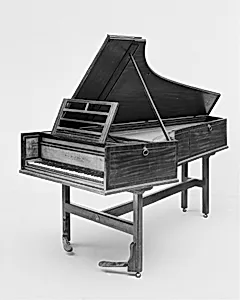
Medium
Mahogany, oak, curly maple, ivory, ebony, brass and various materials
Dimensions
Case length (perpendicular to keyboard): 226.5 cm (89 3/16 in.) Width (parallel to keyboard): 97.8 cm (38 1/2 in.) Case depth without lid: 30 cm (11 13/16 in.) Total height: 92 cm (36 1/4 in.)
Classification
Chordophone-Zither-struck-piano
Culture
British
Department
Musical Instruments
Museum
Metropolitan Museum of Art, New York, NY
Credit
Gift of Mr. and Mrs. Jerome C. Neuhoff, 1957
Accession Number
57.134a–e
Rights
Public Domain
Art Historical Context
Step into the elegant world of18th-century music with this stunning Grand Piano crafted by John Broadwood in1792. As a master piano maker in London, Broadwood helped pioneer the English grand piano, blending exquisite craftsmanship with innovative design. Fashioned from rich mahogany, oak, and curly maple, accented by ivory keys, ebony, and brass, this instrument measures an impressive 226.5 cm in length, embodying the opulence of Georgian-era furniture. Its classification as a chordophone-zither-struck highlights the hammer-action mechanism that struck strings to produce sound, a leap forward from the harpsichord. This piano holds immense historical significance as a product of Broadwood & Sons, whose instruments were favored by composers like Haydn and early Beethoven. By 1792, Broadwood had refined the fortepiano's range and touch, contributing to the piano's rise as the era's premier keyboard instrument for both salons and concert halls. British-made with luxurious tropical woods and fine metals, it reflects the Industrial Revolution's fusion of artistry and technology, symbolizing musical sophistication among the elite. Today, gifted to the Metropolitan Museum of Art in 1957, this grand piano invites visitors to appreciate not just its beauty, but its role in shaping Western classical music. Imagine Mozart-era melodies resonating from its polished case— a timeless treasure of sound and style.