
Grande Arabesque, First Time (Arabesque à terre)
c. 1885/1890
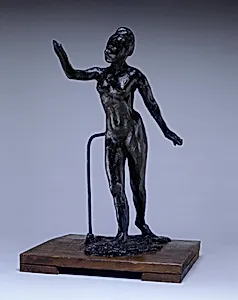
Medium
pigmented beeswax, metal armature, wood slivers, cork, on wooden base
Dimensions
overall without base: 49.5 x 24.5 x 34.8 cm (19 1/2 x 9 5/8 x 13 11/16 in.) height (of figure): 47.9 cm (18 7/8 in.)
Classification
Sculpture
Department
CSD
Museum
National Gallery of Art, Washington, D.C.
Credit
Collection of Mr. and Mrs. Paul Mellon
Accession Number
1999.80.26
Rights
Public Domain
Art Historical Context
**Grande Arabesque, First Time (Arab à terre)** Edgar Degas, the renowned French artist associated with Impressionism, crafted this captivating sculpture around 1885–1890. Though best known for his paintings of ballet dancers, horse races, and modern life, Degas privately created over 150 sculptures in his later years, many depicting the poised grace of dancers. This work captures a ballerina in the elegant "arabesque à terre pose—her body arched low to the ground in a fluid extension of leg and arm—evoking the discipline and ephemerality of ballet performance. The sculpture's innovative medium of pigmented beeswax over a metal armature, augmented with wood slivers and cork on a wooden base, allowed Degas to achieve lifelike softness and subtle color variations impossible in traditional materials like marble or bronze. Standing nearly 48 cm tall (figure height), it exemplifies his experimental approach, blending realism with impressionistic movement. These waxes were not cast or exhibited during Degas' lifetime, making originals like this one exceptionally rare treasures. Housed in the National Gallery of Art through the generosity of Mr. and Mrs. Paul Mellon, *Grande Arabesque* highlights Degas' obsession with capturing fleeting human gesture, bridging his painterly techniques with three-dimensional form. It's a window into the private genius of an artist who revolutionized how we see the body in motion.
About the Artist
Edgar Degas · 1834–1917
Edgar Degas (1834-1917) stands as one of the most innovative artists of the nineteenth century, whose distinctive vision transformed how modern life could be depicted on canvas. Born Hilaire-Germain-Edgar De Gas in Paris to a wealthy banking family—his father French, his mother a Louisiana Creole from New Orleans—Degas received a classical education before abandoning law studies in 1855 to pursue ...