
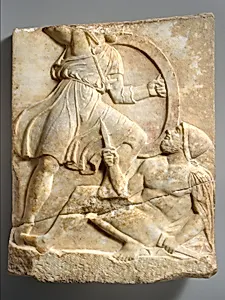
Grave stele with Hoplite Battle Scene
Unknown Artist
ca. 390 BCE
Medium
Marble, Pentelic
Dimensions
Overall: 21 x 16in. (53.4 x 40.6cm)
Classification
Stone Sculpture
Culture & Period
Greek, Attic · Classical
Department
Greek and Roman Art
Museum
Metropolitan Museum of Art, New York, NY
Credit
Fletcher Fund, 1940
Accession Number
40.11.23
Rights
Public Domain
Tags
Art Historical Context
This striking marble grave stele from Athens, carved around 390 BCE, captures the intensity of hoplite warfare in a compact relief just over two feet tall. Crafted from fine Pentelic marble—the same luminous stone used for the Parthenon—the panel shows two armored warriors locked in combat, their shields, spears, and crested helmets rendered with crisp detail. As a funerary monument, it likely marked the burial of a citizen-soldier, turning a private grave into a public reminder of courage and civic duty during the turbulent years after the Peloponnesian War. In Classical Attic art, battle scenes on grave markers honored the deceased while celebrating the hoplite ideal: the disciplined, heavily armed infantryman who fought shoulder-to-shoulder for his city-state. The sculptor’s dynamic composition—bodies overlapping, weapons angled to suggest motion—reveals the technical sophistication of late-fifth-century relief carving, where shallow depth creates a vivid sense of three-dimensional action on a flat surface. Today in the Metropolitan Museum, the stele invites visitors to reflect on how ancient Athenians blended personal loss with collective memory, transforming stone into both memorial and moral lesson.