
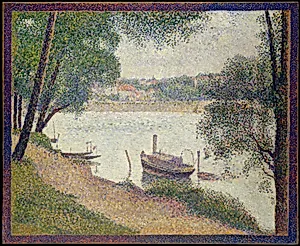
Gray Weather, Grande Jatte
Georges Seurat, ca. 1886–88
About this artwork
Georges Seurat's *Gray Weather, Grande J* (ca. 1886–88), an oil on canvas measuring 27¾ × 34 inches, captures a moody riverside scene along the Seine at the Île de la Grande Jatte, a popular Parisian leisure spot. Painted during Seurat's mature period, it features subtle glimpses of boats dotting the gray waters under overcast skies, evoking tranquility and transience of everyday life. Now in the Metropolitan Museum of Art's European Paintings collection, thanks to Walter H. and Leonore Annenberg Collection, this work exemplifies Seurat's revolutionary approach to modern urban landscapes. Seurat, a pioneer of Pointillism (or Divisionism), applied meticulous dots of pure color rather than blended pigments, relying on the viewer's eye to optically mix hues at a distance. This scientific technique, influenced by optical theories and contemporary color studies, marked a shift from Impressionism toward Post-Impressionism, emphasizing structure and harmony over fleeting impressions. *Gray Weather* likely served as a study related to his monumental *A Sunday Afternoon on the Island of La Grande Jatte* (1884–86), showcasing his methodical process. Its cultural significance lies in bridging 19th-century art with modernism, inviting viewers to ponder the interplay of light, atmosphere, and human presence in industrialized Paris. A quiet gem amid Seurat's bolder compositions, it reveals the master's precision in rendering subtle tonal shifts.