
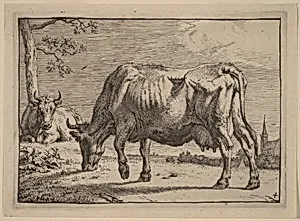
Grazing Cow
1650
Medium
etching
Classification
Department
CG-E
Museum
National Gallery of Art, Washington, D.C.
Credit
Ailsa Mellon Bruce Fund
Accession Number
1982.15.4
Rights
Public Domain
Art Historical Context
Paulus Potter's *Grazing Cow* (1650) captures the serene beauty of the Dutch countryside during the Golden Age, a period when artists celebrated everyday rural life amid Holland's prosperity. Potter, master of animal painting who died young at 29, specialized in lifelike depictions of livestock, blending meticulous observation with dramatic lighting to evoke the quiet majesty of nature. This etching showcases his skill in portraying a single cow grazing peacefully, likely set against a vast landscape that emphasizes harmony between beast and environment. As an etching—a printmaking technique where the artist draws directly onto a metal plate with acid-resistant ground, allowing acid to "bite" intricate lines—*Grazing Cow* highlights Potter's technical prowess. Etchings like this were revolutionary for their spontaneity and detail, making fine art accessible beyond paintings. Potter produced only a handful of prints, making this rare example a gem in the National Gallery of Art's collection, acquired through the Ailsa Mellon Bruce Fund. Visitors will appreciate how Potter's work influenced later animaliers, turning pastoral scenes into profound meditations on transience and the natural world. A testament to 17th-century Dutch ingenuity!
About the Artist
Paulus Potter · 1625–1654
Paulus Potter (1625–1654) was a Dutch Golden Age painter whose short life — he died at just twenty-eight years of age — belied an artistic achievement of remarkable originality and influence. Born in Enkhuizen in 1625, Potter trained under his father, the painter Pieter Potter, and later in Amsterdam and Delft, where he absorbed the technical standards of the flourishing Dutch painting tradition. ...