
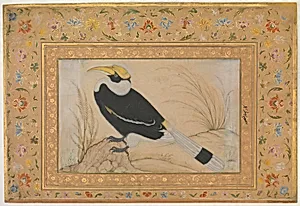
"Great Hornbill", Folio from the Shah Jahan Album
recto: ca. 1540; verso: ca. 1615–20
Medium
Ink, opaque watercolor, and gold on paper
Dimensions
H. 15 1/4 in. (38.7 cm) W. 10 1/2 in. (26.7 cm)
Classification
Codices
Department
Islamic Art
Museum
Metropolitan Museum of Art, New York, NY
Credit
Purchase, Rogers Fund and The Kevorkian Foundation Gift, 1955
Accession Number
55.121.10.14
Rights
Public Domain
Tags
Art Historical Context
Discover the exquisite "Great Hornbill," a double-sided folio from the Shah J Album, housed in the Metropolitan Museum of's Islamic Art collection. The recto features elegant calligraphy by Mir 'Aliavi, a master from Herat, dated around 1540, showcasing the refined nasta'liq script that bridged Persian and Mughal traditions. On the verso, 1615–20, Ustad Mansur—one of Emperor Jahangir's favored court painters—depicts a majestic Great Hornbill with astonishing realism. Rendered in ink, opaque watercolor, and gold on paper (15¼ × 10½ in.), this work exemplifies Mughal miniature painting's precision and vibrancy. Mansur's bird portraits were legendary for their scientific accuracy and lifelike detail, capturing the hornbill's massive casque, iridescent feathers, and alert gaze as if alive. This technique, blending observation with stylized elegance, highlighted the Mughals' fascination with nature, often commissioned to document the empire's biodiversity for imperial albums. Compiled during Emperor Shah Jahan's reign (1628–58), the album gathered treasures from earlier eras, reflecting the court's cosmopolitan taste. Such folios were status symbols, blending Safavid Persian influences with indigenous Indian motifs, and underscore the cultural zenith of Mughal art. A true avian marvel!