
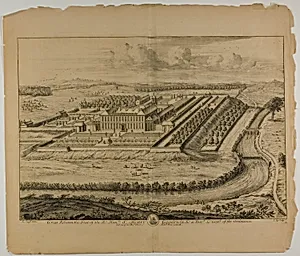
Great Ribston, plate 61 from Britannia Illustrata
published 1707
Medium
Etching and engraving in black on cream laid paper
Dimensions
Image: 32.6 × 47.5 cm (12 7/8 × 18 3/4 in.); Plate: 34.5 × 48.9 cm (13 5/8 × 19 5/16 in.); Sheet: 44.2 × 52 cm (17 7/16 × 20 1/2 in.)
Classification
prints and drawing
Department
Prints and Drawings
Museum
Art Institute of Chicago
Accession Number
198928
Rights
Public Domain
Art Historical Context
**Great Ribston, plate from *Britannia Illustrata Johannes Kip, a skilled Dutch engraver who settled in England, created this stunning topographical view in 1707 as part of *Britannia Illustrata a lavish two-volume work showcasing the grandeur of British estates. Collaborating with painter Jan van Knyff, Kip's engravings over 80 country houses and gardens, celebrating the architectural splendor of the aristocracy during the early 18th century.Great Ribston," likely depicting the historic Ribston Hall estate in Yorkshire—famed for originating the Ribston pippin apple—exemplifies this patriotic project, commissioned amid Britain's growing prosperity post-Glorious Revolution. Rendered through meticulous etching and engraving on cream laid paper, the print measures an impressive 32.6 × 47.5 cm, allowing intricate details of manicured gardens, stately facades, and bustling estate life to shine. Etching provided fluid lines for landscapes, while engraving added precise textures to architecture, a technique that made Kip's works both artistic marvels and historical documents. Housed in the Art Institute of Chicago's Prints and Drawings department, this plate preserves a vanishing world of Baroque symmetry and opulence. Today, it offers a window into England's "Golden Age" of landscaping, influenced by French formal gardens, reminding us how such prints immortalized estates often altered or lost to time. A true gem for history lovers!