
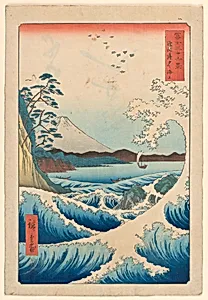
Great Wave at Satta Beach, Suruga, from the series The Thirty-Six Views of Fuji (Fuji Sanjuroku Kei)
Medium
seascapes
Classification
seascapes
Department
Smithsonian Collection
Museum
Smithsonian American Art Museum
Credit
Gift of the Estate of Mrs. Robert H. Patterson
Accession Number
1941-31-120
Rights
Public Domain
About this artwork
Research in Progress
Art Historical Context
Ando Hiroshige (1797–1858), one of Japan's foremost ukiyo-e masters, created *Great Wave at Satta, Suruga*, from final and most celebrated series, *The Thirty-Six of Mount Fuji* (Fuji Sanjuroku Kei), in 1858—the year of his death. This seascape captures the raw power of nature, with towering waves crashing against the shore at Satta Beach in Suruga Province, while the iconic Mount Fuji looms distantly under a dramatic sky. Hiroshige work reflects the late Edo-period fascination with landscapes, blending poetic beauty with everyday scenes to evoke the transient beauty of life, a core ukiyo-e principle meaning "pictures of the floating world." As a color woodblock print, the artwork showcases Hiroshige's innovative techniques, including precise gradations of color (bokashi) and bold compositions that heighten emotional impact. Published amid Japan's isolationist sakoku policy, just before the Meiji Restoration opened the country to the West, these prints became cultural ambassadors, influencing European artists like Van Gogh and Monet. This piece, now in the Smithsonian American Art Museum's collection (gift of the Estate of Mrs. Robert H. Patterson), exemplifies Hiroshige's legacy in elevating humble views into timeless meditations on nature's majesty. (198 words)