
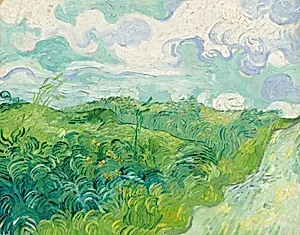
Green Wheat Fields, Auvers
1890
Medium
oil on canvas
Dimensions
overall: 72.39 × 91.44 cm (28 1/2 × 36 in.)
Classification
Painting
Department
CF
Museum
National Gallery of Art, Washington, D.C.
Credit
Collection of Mr. and Mrs. Paul Mellon
Accession Number
2013.122.1
Rights
Public Domain
Art Historical Context
Vincent van Gogh painted *Green Wheat Fields, Auvers* in 1890 during the final months of his life, while living in the rural village of Auvers-sur-Oise, France. This oil on canvas captures the rolling countryside with vibrant greens and golden hues, reflecting the artist’s deep fascination with nature’s rhythms and the changing seasons. Created just weeks before his death, the work belongs to a remarkable burst of productivity that included dozens of landscapes and portraits. Van Gogh’s distinctive Post-Impressionist style shines through the painting’s thick, energetic brushstrokes and expressive color contrasts. Rather than simply recording the scene, he transformed the wheat fields into a living, almost emotional landscape, where swirling lines and bold textures convey both vitality and inner turbulence. The large scale—roughly 28 by 36 inches—allows viewers to feel immersed in the open fields. Today in the National Gallery of Art’s collection, this painting stands as a powerful example of Van Gogh’s ability to infuse ordinary rural subjects with profound feeling, offering visitors a moving glimpse into the artist’s final creative chapter.
About the Artist
Vincent van Gogh · 1853–1890
Vincent Willem van Gogh (1853-1890) stands as one of the most influential figures in Western art history, despite a career spanning merely a decade. Born in Groot-Zundert, Netherlands, to a Protestant pastor's family, van Gogh's path to artistic greatness was anything but conventional. His early adulthood saw him working as an art dealer for Goupil & Cie, a language teacher, and a fervent missiona...