
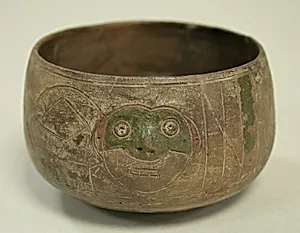
Greyware Bowl with Incised Monkeys
Unknown Artist
3rd century BCE
Medium
Ceramic
Dimensions
H. 2 1/4 × Diam. 3 7/8 in. (5.7 × 9.8 cm)
Classification
Ceramics-Containers
Culture
Paracas
Department
Arts of Africa, Oceania, and the Americas
Museum
Metropolitan Museum of Art, New York, NY
Credit
Gift of Nathan Cummings, 1963
Accession Number
63.232.74
Rights
Public Domain
Tags
Art Historical Context
This delicate Greyware Bowl with Incised Monkeys, by an unknown Paracas artist around the 3rd century, exemplifies the refined ceramic traditions of ancient Peru's Paracas culture. Measuring just 2¼ inches high and 3⅞ inches in diameter, this small container from the Metropolitan Museum of Art's Arts Africa, Oceania, and Americas department was a gift from Nathan Cummings in 196. Its smooth grey surface, achieved through a reduction firing process that limits oxygen to create the characteristic color, bears finely incised motifs of playful monkeys—lively figures etched into the clay before firing. The Paracas, who thrived along Peru's southern coast from about 800–100 BCE, were masterful potters known for their elegant, minimalist ceramics. Incising allowed artists to create intricate designs that stood out against the polished greyware, often depicting animals symbolizing the natural world or spiritual beliefs. Monkeys, in particular, evoke the fauna of the Andean region, possibly carrying cultural significance in rituals or daily life. As a surviving example of Paracas vessel artistry, this bowl offers a window into a pre-Inca society celebrated for its textiles and burials. Though utilitarian, its artistic precision highlights the culture's aesthetic sophistication, bridging function and symbolism in everyday objects. Visitors can appreciate how such pieces reveal the ingenuity of early American civilizations.