
Gröfin Auersperg
1850s–60s
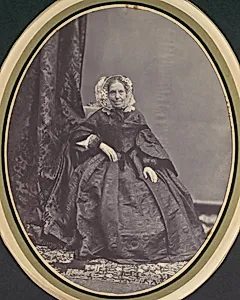
Medium
Albumen silver print from glass negative
Dimensions
21.8 x 17.2 cm. (8 9/16 x 6 3/4 in.)
Classification
Photographs
Department
Photographs
Museum
Metropolitan Museum of Art, New York, NY
Credit
David Hunter McAlpin Fund, 1948
Accession Number
48.83.1
Rights
Public Domain
Tags
Art Historical Context
**Gröfin Auersperg** is a striking portrait by Franz Antoine, a pioneering Austrian photographer active in the-19th century. Captured in the 1850s–60s, it depicts Countess (Gröfin) Auersperg, a member of the Viennese nobility embodying the elegance of Habsburg-era aristocracy. Antoine, for his work as a court photographer, in formal portraits that preserved the grandeur Europe's elite during photography's formative years. This albumen silver print, made a glass negative, exemplifies photographic innovation. The albumen—using egg whites to coat paper with light-sensitive silver salts—produced images with exceptional clarity, tonal richness, and subtle gradations, revolutionizing portraiture. At 21.8 x 17.2 cm, its intimate scale invites close viewing, highlighting the countess's poised expression and refined attire against a neutral backdrop, a hallmark of Antoine's precise, studio-based style. Held in the Metropolitan Museum of Art's Photographs Department (David Hunter McAlpin Fund, 1948), this work underscores photography's rapid rise as a democratic yet status-affirming medium. It captures a pivotal moment when cameras began rivaling painted portraits, democratizing access to likenesses while reinforcing class distinctions through tags like "Women" and "Portraits." A window into 19th-century Viennese high society, it reminds us how technology reshaped self-presentation.
About the Artist
Franz Antoine · 1815–1886
Franz Antoine (1815–1886) was an Austrian botanist and horticulturalist who served as court gardener at the Imperial Gardens of Schönbrunn in Vienna, one of the most celebrated horticultural establishments in nineteenth-century Europe. His career unfolded at the intersection of scientific botany and the decorative arts of the garden, positioning him as a key figure in the cultivation and documenta...