
Grotesque Borders for Rooms & Halls
Medium
Hand-colored etching
Dimensions
Sheet (Trimmed): 13 in. × 18 7/16 in. (33 × 46.9 cm)
Classification
Prints
Department
Drawings and Prints
Museum
Metropolitan Museum of Art, New York, NY
Credit
Harris Brisbane Dick Fund, 1917
Accession Number
17.3.888-281
Rights
Public Domain
Tags
Art Historical Context
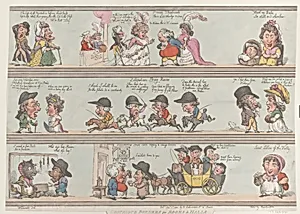
**Grotesque Borders for Rooms Halls** (December 1, 1800) is a delightful hand-colored etching by the celebrated British caricaturist Thomas Rowland, in collaboration with publisher Rudolph Ackermann of London and artist George Matroyd Woodward. Measuring about 13 by 18 inches, this from the Metropolitan Museum of Art's Drawings and Prints collection captures the whimsical spirit of Regency-era satire. Hand-coloring on etching—a popular technique of the time—brought vibrant life to intricate line work, making these designs pop as affordable, decorative art for homes. The title hints at its playful purpose: ornamental border designs for rooms and halls, twisted into "grotesque" fantasies teeming with exaggerated figures of men, women, horses, and carriages. Rowlandson, a master of comic exaggeration, skewers social follies through bustling, chaotic vignettes—imagine pompous gentry tumbling from carriages amid frenzied equine antics. Published by Ackermann, whose Repository of Arts popularized such prints, it reflects early 19th-century Britain's print culture boom, where satire adorned middle-class walls like cheeky wallpaper. This piece highlights the era's cultural zest for humor amid industrial change and social upheaval, blending high art with lowbrow laughs. A charming window into Georgian wit! (198 words)
About the Artist
Thomas Rowlandson|Rudolph Ackermann, London|George Murgatroyd Woodward · 1756–1827
Thomas Rowlandson (1757–1827) was an English artist and caricaturist whose satirical watercolors and prints captured the social life of Georgian Britain with unparalleled wit and technical mastery. Alongside James Gillray, he is recognized as one of the greatest British graphic artists, and his distinctive flowing line and keen observations have made his work integral to understanding late 18th an...