
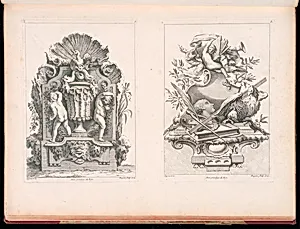
Grotesque Exedra Design
Medium
Bound print
Classification
Bound print
Department
Smithsonian Collection
Museum
Smithsonian American Art Museum
Credit
Purchased for the Museum by the Advisory Council
Accession Number
1921-6-216-90
Rights
Public Domain
About this artwork
Research in Progress
Art Historical Context
Gilles-Marie Oppenord (1672–1742), a prominent French architect and ornamental designer of the Régence period, created intricate patterns that bridged Baroque grandeur and the lighter Rococo style. *Grotesque Exedra*, a bound print from a publication dated 1749–1761—after the artist's death—showcases his mastery of fantastical motifs. Oppenord's work often drew from ancient Roman "grottesche" decorations discovered in Nero's Domus Aurea, revived during the Renaissance and adapted into whimsical, asymmetrical vignettes of flora, fauna, and mythical figures. An exedra, typically a semicircular recess for conversation or display, here becomes a canvas for Oppenord's elaborate grotesques, blending architecture with playful ornamentation. As a bound print, this piece likely originated from one of his influential pattern books, used by artisans across Europe to replicate designs in interiors, furniture, and silverwork. Such prints democratized high-style decoration, influencing 18th-century taste. Acquired by the Smithsonian American Art Museum through the Advisory Council, this work highlights the transatlantic appeal of French design in American collections. Though research continues, it exemplifies how printed designs preserved and spread innovative aesthetics, inviting visitors to imagine opulent salons alive with Oppenord's imaginative flair.