
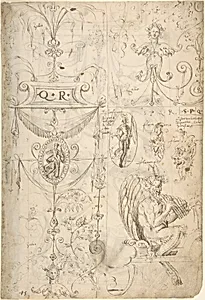
Grotesques Designs with Various Inscriptions (recto); Candelabra Grotesque and Two Putti Holding Flowers (verso)
ca. 1545–60
Medium
Pen and dark gray-brown ink (recto). On off-white paper. Pen and brown ink over traces of black chalk underdrawing (verso). Drawing on verso pricked on figures of putti and shells below them
Dimensions
13-1/4 x 9 in. (33.7 x 22.9 cm)
Classification
Drawings|Ornament & Architecture
Department
Drawings and Prints
Museum
Metropolitan Museum of Art, New York, NY
Credit
The Elisha Whittelsey Collection, The Elisha Whittelsey Fund, 1952
Accession Number
52.570.329
Rights
Public Domain
Tags
Art Historical Context
Created around 1545–60 by artist Andrés de Melgar *Grotesques Designs with Inscriptions (recto); Candelabra Grotesque Two Putti Holding Flowersverso)* showcases the whimsical ornamental style that captivated Renaissance Europe. On the recto, intricate pen and dark gray-brown ink sketches blend mythical creatures, musical instruments, decorative motifs, interspersed with inscriptions on off-white paper. The verso a lively candelabra grotesque—those fantastical, intertwined forms inspired by ancient Roman frescoes—rendered in brown ink over black chalk underdrawing, with playful putti (cherubic figures) clutching flowers. Notably, the putti and shells below are pricked, a technique used to transfer designs onto walls or panels via pouncing with charcoal dust. Grotesques like these exploded in popularity during the 16th century, influencing architecture, prints, and decorative arts from Italy to Spain. Melgar, active in Rome, drew from this vogue, evident in the sheet's classification as Ornament & Architecture. The dual-sided composition and precise ink work highlight its role as a pattern sheet for artisans, bridging drawing and craft. Housed in the Metropolitan Museum of Art's Elisha Whittelsey Collection since 1952, this 13¼ x 9 in. gem invites visitors to appreciate how such fantastical designs adorned palaces and churches, blending myth, music, and exuberant fantasy into enduring visual delight.