
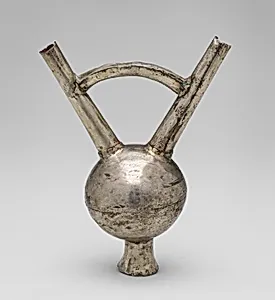
Group of miniatures
12th–15th century
Medium
Silver (hammered)
Dimensions
H. 3 3/4 × W. 2 7/8 × D. 1 1/2 in. (9.5 × 7.4 × 3.8 cm)
Classification
Metal-Containers
Culture
Chimú or Chancay
Department
Arts of Africa, Oceania, and the Americas
Museum
Metropolitan Museum of Art, New York, NY
Credit
Bequest of Jane Costello Goldberg, from the Collection of Arnold I. Goldberg, 1986
Accession Number
1987.394.681
Rights
Public Domain
Art Historical Context
Nestled in the Metropolitan Museum of Art's collection of Arts of Africa,, and the Americas, *Group of Miniatures* showcases the exquisite metalworking prowess of Chimú or Chancay artisans from Peru's north coast, dating to the 12th–15th century. During the Late Intermediate Period, the Chim built a vast empire known for monumental architecture and sophisticated crafts, while the Chancay in textiles and ceramics before their absorption into Chimú territory around 1450. These tiny silver containers—measuring just under 4 inches high—likely served elite functions, perhaps as ritual vessels, cosmetic holders, or offerings to deities, reflecting the cultures' reverence for precious metals symbolizing wealth and spiritual power. Crafted from hammered silver, the miniatures highlight advanced repoussé techniques, where thin sheets were meticulously shaped, chased, and tooled to create delicate forms. This labor-intensive process demanded exceptional skill, transforming raw metal into intricate, portable treasures that could be worn or carried by nobility. The modest dimensions belie their cultural weight: in Chimú and Chancay societies, such objects underscored social hierarchies and connections to the divine. Bequeathed in 1986 from the Collection of Arnold I. Goldberg, these miniatures invite us to marvel at pre-Columbian ingenuity, bridging everyday utility with sacred artistry in ancient Peru.