
Guan Yu, Chinese God of War
Katsushika Hokusai, 19th century
About this artwork
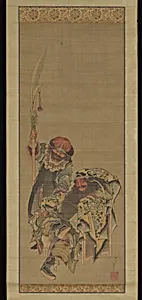
In the grand tradition of Edo-period Japanese art, Katsushika Hai (1760–1849)—best known for his iconic wood prints like *The Great off Kanagawa*—presents *Guan Yu, Chinese God of War* as a magnificent hanging scroll. Created in the 19th century, this and color on silk painting measures about 33½ by 13½ inches its image area, designed to be unrolled for intimate viewing in a home or temple alcove. Hokusaifully captures the fierce yet dignified Guan Yu, a deified Chinese general from the 3rd century, revered for his loyalty and martial prowess in the epic *Romance of the Three Kingdoms*. Guan Yu's image transcended China to become a protective deity in Japan, symbolizing bravery and righteousness during the Edo period (1615–1868), a time of relative peace when warrior ideals persisted in art and folklore. Hokusai's depiction blends Chinese iconography—Guan Yu's signature red face, flowing beard, and green robe—with Japanese finesse, showcasing his versatility beyond ukiyo-e prints into literati painting styles influenced by Zen ink traditions. The silk medium allows for luminous colors and fluid brushwork, highlighting Hokusai's innovative techniques: bold ink outlines contrasted with subtle washes, evoking the god's otherworldly power. Acquired by the Metropolitan Museum of Art through the Seymour Fund in 1959, this scroll invites visitors to ponder the cultural exchange between China and Japan, where a warrior's legend endures as timeless inspiration.