
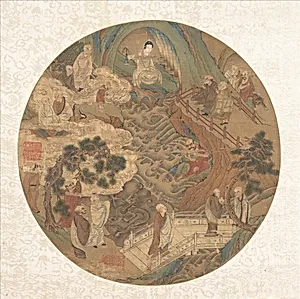
明 佚名 觀音羅漢圖 扇|Guanyin and the sixteen luohans
16th–17th century
Medium
Round fan mounted as an album leaf; ink, color, and gold on silk
Dimensions
Sheet: H. 12 in. (30.5 cm); W. 12 1/4 in. (31.1 cm); Diam. 8 3/8 in. (21.3 cm)
Classification
Paintings
Culture & Period
China · Ming dynasty (1368–1644)
Department
Asian Art
Museum
Metropolitan Museum of Art, New York, NY
Credit
John Stewart Kennedy Fund, 1913
Accession Number
13.100.123
Rights
Public Domain
Tags
Art Historical Context
This exquisite round fan painting, now mounted as an album leaf dates to the Ming dynasty (8–1644), likely from the 16th or 17th century. Titled *Guanyin and the Luohans*, it the compassionate Bodhisattva Guany surrounded by the sixteen luohans—enlight disciples of the Buddha revered as protectors of Buddhist teachings. Rendered in ink, color, and gold on silk, work captures a serene Buddhist gathering amid landscapes featuring bridges, evoking a sense of spiritual harmony and journey. In Ming China, such fan paintings were prized for their portability and intimacy, often carried by scholars and elites as personal talismans. The inclusion of Guanyin, a female bodhisattva embodying mercy, alongside the male luohans reflects the era's deep devotion to Mahayana Buddhism, blending divine figures with everyday motifs like bridges symbolizing passage to enlightenment. Gold accents highlight sacred elements, a technique that added luminosity and reverence to silk supports. Acquired through the John Stewart Kennedy Fund in 1913, this anonymous masterpiece from the Metropolitan Museum of Art's Asian Art collection showcases Ming artists' mastery of delicate, narrative compositions. It invites viewers to contemplate compassion and wisdom in a compact, jewel-like format.