
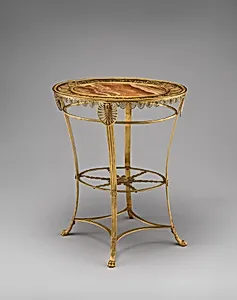
Guéridon
ca. 1810
Medium
Gilt yellow metal, alabaster
Dimensions
Overall: 29 × 23 1/4 × 19 1/4 in. (73.7 × 59.1 × 48.9 cm)
Classification
Metalwork-Gilt Bronze
Culture
German, Berlin
Department
European Sculpture and Decorative Arts
Museum
Metropolitan Museum of Art, New York, NY
Credit
Gift of Kenneth Jay Lane, 2014
Accession Number
2014.435.4
Rights
Public Domain
Art Historical Context
This elegant *Guéridon* by the Berlin firm Werner & Mieth, dating to around 1810, is a masterful example of early 19th-century German arts. Standing 29 inches tall with a 23¼ × 19¼-inch footprint, it combines shimmering gilt yellow metal—likely bronze—with a smooth alabaster top, creating a luxurious pedestal table ideal for displaying fine objects or serving delicacies. Housed in the Metropolitan Museum of Art's Department of European Sculpture and Decorative Arts, it reflects the opulence of Prussian elite interiors. Crafted during Berlin's Neoclassical flowering, influenced by ancient Greco-Roman forms and the Napoleonic Empire style, the guéridon showcases meticulous metalworking techniques. Artisans applied gilding—a process of mercury amalgamation or electroplating precursors—to achieve its radiant gold finish over bronze, paired with alabaster's cool translucency for striking contrast. Such pieces were status symbols in aristocratic homes, blending functionality with sculptural grace. Generously gifted by jewelry designer Kenneth Jay Lane in 2014, this guéridon highlights Berlin workshops' pivotal role in Europe's luxury trade, bridging furniture and fine art traditions.