
Guilford Painted Chest
c. 1936
Medium
watercolor, gouache, and pen and ink on paper
Dimensions
overall: 24.4 x 34.4 cm (9 5/8 x 13 9/16 in.) Original IAD Object: 42"long; 43"high; 19"wide
Classification
Index of American Design
Department
CG-W
Museum
National Gallery of Art, Washington, D.C.
Credit
Index of American Design
Accession Number
1943.8.4676
Rights
Public Domain
Art Historical Context
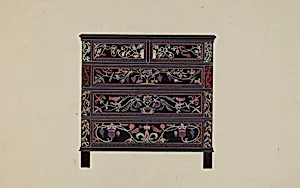
Step into the vibrant world of American folk art with *Guilford Painted Chest*, meticulous rendering by artist Martin Partyka created around 1936. This watercolor, gouache, and-and-ink work on paper (24.4 x 34.4 cm) captures the intricate details of a traditional painted chest measuring 42 inches long,43 inches high, and19 inches wide. Housed in the National Gallery of Art's Index of American Design collection, showcases Partyka's skill in translating the chest's decorative motifs—likely floral patterns and bold colors typical of early American craftsmanship—into a vivid, two-dimensional study. The artwork is part of the Index of American Design (1935–1942), a groundbreaking WPA Federal Art Project initiative during the Great Depression. Artists like Partyka documented everyday objects of American material culture, from furniture to textiles, to preserve and celebrate the nation's artistic heritage amid economic hardship. This effort produced over 15,000 renderings, highlighting regional styles and folk traditions. Partyka's mixed-media technique—combining the fluidity of watercolor and gouache for rich hues with precise pen-and-ink lines—brings the chest's three-dimensional form and painted surfaces to life, emphasizing its cultural importance as a symbol of colonial-era ingenuity, possibly from Connecticut's Guilford region. A testament to American creativity, it invites visitors to appreciate how everyday heirlooms embody history.
About the Artist
Martin Partyka · 1855–present
Martin Partyka is an artist whose biographical record is sparse. No confirmed dates of birth or death have been established, and his nationality and geographic context remain unverified in the available literature. Despite this uncertainty, Partyka's surviving works — held in museum collections — indicate an active artistic practice. The number and range of pieces attributed to him suggest a work...