
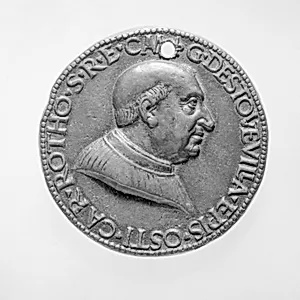
Guillaume d'Estouteville
after 1461
Medium
Bronze
Dimensions
Diameter: 46 mm
Classification
Medals and Plaquettes
Culture
Italian, Rome
Department
European Sculpture and Decorative Arts
Museum
Metropolitan Museum of Art, New York, NY
Credit
Bequest of Rupert L. Joseph, 1959
Accession Number
60.55.51
Rights
Public Domain
Tags
Art Historical Context
This exquisite bronze medal, titled *Guillaume d'Estoute* and crafted by the Roman medalist Cristoforo diemia after 1461, captures the profile of the French cardinal and papal official in a classic Renaissance style. Measuring just 46 mm in diameter, it exemplifies the intimate scale of *medals and plaquettes*—small, collectible sculptures that revived ancient Roman coin traditions during Italy's Quattrocento revival of classical antiquity. The obverse likely features the cardinal's dignified profile, while the reverse bears his coat of arms, blending portraiture with heraldry. Guillaume d'Estouteville (c. 1400–1461) rose to prominence in the Roman Curia under Popes Eugene IV and Nicholas V, serving as a key administrator and even a contender for the papacy. Created posthumously or soon after his death, this medal commemorates his legacy amid the bustling cultural and ecclesiastical life of mid-15th-century Rome. Cristoforo di Geremia, active in the Eternal City, was renowned for such finely wrought bronzes, which served as diplomatic gifts, personal mementos, and status symbols among Europe's elite. Artistically, the medal showcases masterful casting techniques, with sharp incised details in the facial features and heraldic motifs that highlight the era's precision in small-scale metalwork. Housed in the Metropolitan Museum of Art's European Sculpture and Decorative Arts collection (Bequest of Rupert L. Joseph, 1959), it invites visitors to appreciate how these portable artworks bridged antiquity and the Renaissance, personalizing history in gleaming bronze.