
Guri cupstand
Unknown Artist
1368–1644
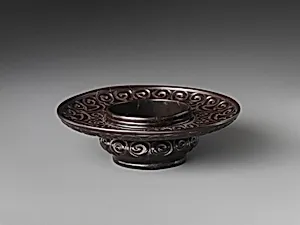
Medium
Black lacquer
Dimensions
Diam. of rim: 7 5/8 in. (19.4 cm) Diam. of foot: 3 1/8 in. (7.9 cm)
Classification
Lacquer
Culture & Period
China · Ming dynasty (1368–1644)
Department
Asian Art
Museum
Metropolitan Museum of Art, New York, NY
Credit
Gift of Florence and Herbert Irving, 2015
Accession Number
2015.500.1.72
Rights
Public Domain
Art Historical Context
This elegant **Guri cupstand**, crafted during China's Ming dynasty (1368–1644), exemplifies the era's mastery of lacquerware. Made of black lacquer, it features a wide rim (7⅝ inches in diameter) that gracefully flares outward to support a cup, tapering to a sturdy foot (3⅛ inches across). Produced by an unknown artist, such objects were essential accessories in elite banquets and tea ceremonies, elevating drinking vessels to prevent spills and showcase refined taste. The "guri" design—evident in the object's name—refers to a distinctive swirling, horn-like motif achieved through layered lacquering techniques. Artisans applied multiple coats of lacquer, often in contrasting colors beneath the black surface, then meticulously carved to reveal intricate spirals. This labor-intensive process, perfected in the Ming period, highlighted technical virtuosity and symbolized imperial luxury, as lacquerware rivaled porcelain in prestige. Housed in the Metropolitan Museum of Art's Asian Art Department (gift of Florence and Herbert Irving, 2015), this cupstand invites us to appreciate Ming China's cultural zenith, where everyday rituals became canvases for artistic innovation.