
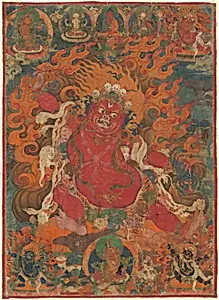
Guru Dragpo
Unknown Artist
18th century
Medium
Distemper on cotton
Dimensions
Image: 24 in. × 17 1/2 in. (61 × 44.5 cm) Framed: 33 1/16 × 25 13/16 in. (84 × 65.5 cm)
Classification
Paintings
Culture
Tibet
Department
Asian Art
Museum
Metropolitan Museum of Art, New York, NY
Credit
Purchase, Friends of Asian Art Gifts, 2015
Accession Number
2015.269
Rights
Public Domain
Tags
Art Historical Context
This striking 18th-century Tibetan painting portrays Guru Dragpo, a wrathful manifestation of a revered Buddhist teacher, rendered in vivid distemper on cotton. Created in Tibet, the work belongs to the tradition of thangka painting, which served both as devotional objects and meditative aids. The compact format—measuring just 24 by 17½ inches—allowed these images to be rolled and carried between monasteries or used in personal shrines, reflecting the portable nature of Tibetan Buddhist practice during this period. The composition draws on rich iconographic elements visible in the tags: skulls symbolizing the impermanence of life, elephants evoking strength and the taming of the mind, and the central fierce deity embodying protective energy within Buddhism. Distemper, a technique using mineral pigments bound with glue, produces the luminous yet durable colors typical of Tibetan works, ensuring the painting’s vibrancy for ritual use over centuries. Acquired by the Metropolitan Museum in 2015 through the Friends of Asian Art, this piece offers visitors a window into the spiritual and artistic heritage of Tibet, where such deities guided practitioners toward enlightenment by confronting inner obstacles.