
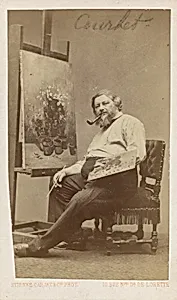
Gustave Courbet
c. 1860s
Medium
albumen print (carte-de-visite)
Dimensions
image/sheet: 9.2 × 5.7 cm (3 5/8 × 2 1/4 in.) mount: 10.5 × 6.3 cm (4 1/8 × 2 1/2 in.)
Classification
Photograph
Department
CPH
Museum
National Gallery of Art, Washington, D.C.
Credit
Gift of Funds from Robert B. Menschel and the Vital Projects Fund
Accession Number
2022.174.6
Rights
Public Domain
Art Historical Context
Step into the revolutionary world of 19th-century France with this intimate carte-de-visite portrait of Gustave Cour, captured by photographer Étienne Carjat around the 1860s. Courbet, the bold leader of Realism, stares directly at the viewer with his signature intense gaze and unruly beard, embodying the defiant spirit that challenged academic art norms. This small albumen print—measuring just 9.2 × 5.7 cm—served as a portable celebrity keepsake, much like a modern trading card. Invented in 1854 by André-Adolphe-Eugène Disdéri, the carte-de-visite format exploded in popularity during the 1860s, allowing everyday people to collect images of cultural icons. Carjat, a master portraitist who also photographed Victor Hugo and Charles Baudelaire, excelled at conveying personality through subtle lighting and composition. The albumen process, using egg-white sensitized paper, produced the era's richest tones and finest details, making these tiny photos surprisingly vivid. Housed in the National Gallery of Art's photography collection, this piece highlights photography's role in democratizing portraiture and immortalizing Realism's firebrand. A gift from Robert B. Menschel and the Vital Projects Fund, it invites us to ponder Courbet's legacy—from his landmark *The Stone Breakers* to his political radicalism—frozen in a moment of quiet power.
About the Artist
Étienne Carjat · 1828–1906
French, Fareins 1828–1906 Paris