
Gustavus Adolphus
1632
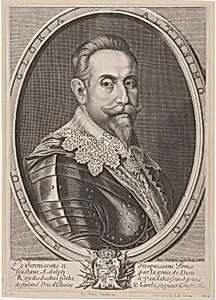
Medium
engraving
Dimensions
plate: 43.5 × 30.7 cm (17 1/8 × 12 1/16 in.)
Classification
Department
CG-E
Museum
National Gallery of Art, Washington, D.C.
Credit
Rosenwald Collection
Accession Number
1950.14.574
Rights
Public Domain
Art Historical Context
This engraving by Michel Lasne captures Gustavus Adolphus, the celebrated King of Sweden, at a pivotal moment in European history. Created in 1632, the same year the monarch died at the Battle of Lützen during the Thirty Years’ War, the print likely served as a commemorative portrait. Lasne, a skilled French engraver active in Paris, specialized in rendering likenesses of royalty and military leaders, helping to spread their images across borders through the reproducible medium of print. Engravings like this one played an essential role in seventeenth-century culture. Unlike unique paintings, they could be produced in multiple impressions and distributed widely, allowing viewers throughout Europe to encounter the Swedish king’s features and symbols of authority. The sizable plate—over seventeen inches tall—suggests it was intended for display rather than inclusion in a book, underscoring Gustavus Adolphus’s status as a Protestant hero and innovative military commander. Today, this impression in the National Gallery of Art’s Rosenwald Collection preserves both the artistry of Lasne’s precise line work and the historical memory of a ruler whose campaigns reshaped the balance of power in early modern Europe.
About the Artist
Michel Lasne · 1590–1667
Michel Lasne (ca. 1590–1667) was a French engraver, draughtsman, and collector who became one of the most prolific printmakers of the French Baroque period. Born in Caen around 1590, Lasne was the son of a goldsmith, which provided him with early exposure to metalworking techniques essential for engraving. His career spanned the reigns of Louis XIII and the early years of Louis XIV, during which h...