
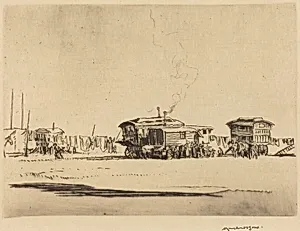
Gypsy Vans, Petersfield Fair, Hampshire
Medium
drypoint
Dimensions
sheet (irreg.): 20.3 × 27.9 cm (8 × 11 in.)
Classification
Department
CG-W
Museum
National Gallery of Art, Washington, D.C.
Credit
Rosenwald Collection
Accession Number
1943.3.2016
Rights
Public Domain
Art Historical Context
**Gypsy Vans, Petersfield Fair, Hampshire** (1914) by Sir Muirhead Bone captures a lively snapshot of rural English life on the cusp of World War I. drypoint print depicts the colorful chaos of Petersfield Fair in Hampshire, with gypsy vans—traditional caravans of traveling Romani communities—amidst the fairground bustle. Bone, a renowned Scottish artist and master printmaker knighted for his contributions, excelled at portraying Britain's architectural and everyday scenes with meticulous detail and atmospheric depth, evoking a sense of nostalgia for vanishing traditions. The medium of drypoint is key to the work's allure. Bone incised lines directly into a copper plate with a sharp needle, raising a soft burr that produces rich, velvety textures in the print—ideal for conveying the textures of canvas tents, wooden wagons, and the fair's hazy energy. At just 8 × 11 inches, this intimate sheet-sized work (from the National Gallery of Art's Rosenwald Collection) invites close viewing, highlighting Bone's precision in a technique prone to only a few strong impressions before the burr wears down. Created in 1914, the print reflects pre-war Britain's romantic fascination with gypsy culture and country fairs, soon overshadowed by global conflict. Bone's topographical eye preserves this fleeting moment, blending documentary realism with poetic charm for modern viewers.
About the Artist
Sir Muirhead Bone
Sir Muirhead Bone (1876–1953), born David Muirhead Bone in Partick, Glasgow, to a journalist father and descended from a family of printers, showed early artistic promise. Apprenticed at fourteen first as a porcelain painter and then as an architect's draughtsman for four years, he honed his draughtsmanship while attending evening classes at the Glasgow School of Art under teachers Archibald Kay a...