
Hackensack Meadows
Jasper Francis Cropsey, 1890
About this artwork
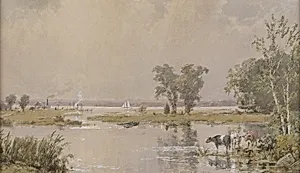
Jasper Francis Cropsey's *Hackensack Meadows*1890) captures the serene beauty of New Jersey's expansive wetlands, a landscape dotted with meandering rivers and grazing cows As a leading figure in the Hudson River School, Cropsey was renowned for his luminous depictions of the American countryside, emphasizing nature's grandeur and the changing seasons. This late-career work reflects his lifelong passion for pastoral scenes, evoking a sense of tranquility amid the meadows' vast skies and watery expanses. Rendered in watercolor, gouache, and graphite on off-white wove paper (12 x 20 1/2 in.), the piece showcases Cropsey's mastery of mixed media. Watercolor provides ethereal transparency for atmospheric effects, while gouache adds rich opacity to foliage and earth tones, and graphite offers precise underdrawing. These techniques, honed through decades of training, highlight the Hudson River School's blend of Romantic idealism and meticulous observation, making watercolors prized for their portability and vividness in the 19th century. Housed in The Metropolitan Museum of Art's American Wing, this gift from Mrs. John C. Newington in 1992 preserves a snapshot of pre-industrial America. It underscores cultural values of the Gilded Age—admiration for untamed wilderness amid rapid urbanization—and invites viewers to ponder humanity's harmony with nature.