
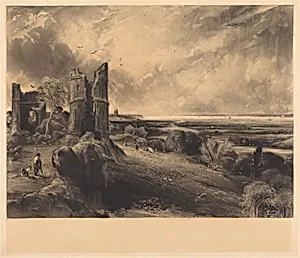
Hadleigh Castle (Large Plate)
1830 and 1832
Medium
mezzotint [progress proof]
Dimensions
sheet: 42.3 × 50.3 cm (16 5/8 × 19 13/16 in.)
Classification
Department
CG-E
Museum
National Gallery of Art, Washington, D.C.
Credit
Paul Mellon Collection
Accession Number
1975.46.11
Rights
Public Domain
Art Historical Context
Behold the dramatic ruins of Hadleigh Castle perched on crumbling cliffs overlooking the Thames estuary in this striking mezzotint progress proof, *Hadleigh Castle (Large)*. Created by engraver David Lucas after John Constable's monumental 1829 oil painting, it captures the Romantic sublime—nature's raw power reclaiming human structures amid stormy skies and turbulent seas. Produced between 1830 and1832, this print belongs to Constable's ambitious *English Landscapes* series, collaborative project blending the painter's luminous vision with Lucas's masterful printmaking. Mezzotint, a "dark manner" intaglio technique invented in the 17th century, revolutionized print reproduction by allowing velvety blacks and subtle gradations of tone—perfect for evoking Constable's atmospheric effects. As a progress proof, this sheet (42.3 × 50.3 cm) reveals the iterative process: rough burr textures yield to refined details, offering a rare glimpse into the artist's workshop evolution before the final polished state. Housed in the National Gallery of Art's Paul Mellon Collection, this work underscores 19th-century Britain's fascination with national heritage and the Picturesque. It democratized Constable's genius, making his evocative landscapes accessible beyond elite canvases, and remains a testament to the harmonious painter-engraver partnership that elevated British printmaking.