
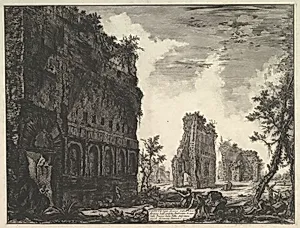
Hadrian's Villa: The Piazza d'Oro (Piazza of Gold) (Veduta degli Avanzi della Circonferenza delle antiche Fabbriche di una delle Piazze della Villa Adriana oggidi chiamata Piazza d'oro)
Giovanni Battista Piranesi, ca. 1776
About this artwork
Step into the sun-drenched ruins of Emperor Hadrian's opulent villa near Tivoli, Italy, captured in Giovanni Battista Piranesi's masterful etching *Hadrian's Villa: Piazza d'Oro* (ca. 1776). This panoramic "veduta" (view) showcases the Piazza of Gold, a lavish courtyard within the sprawling 2nd-century complex designed as Hadrian's private retreat. Built around 118–134 CE, the villa blended Greek, Egyptian, and Roman influences, the emperor's eclectic tastes and imperial power—spaces like this hosted banquets and intellectual gatherings amid intricate mosaics and fountains. Piranesi, a Venetian-born architect and printmaker (1720–1778), revolutionized the depiction of Roman antiquities with his dramatic etchings. Part of his seminal *Vedute di Roma* series, this work measures an impressive 18⅝ × 24½ inches, its intricate lines conveying the sublime beauty and melancholy of decay. Tiny human figures—tourists and scholars—dot the scene, emphasizing the ruins' vast scale and inviting viewers to ponder time's passage. As an etching, the print's rich tonal depth and architectural precision highlight Piranesi's virtuosity, blending factual survey with romantic imagination. Housed in the Metropolitan Museum of Art's Drawings and Prints department, it celebrates the 18th-century Grand Tour fascination with classical heritage, bridging ancient grandeur and Enlightenment curiosity.