
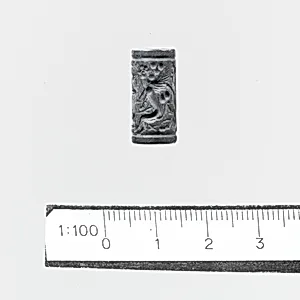
Haematite cylinder seal
Unknown Artist
ca. 1400–1300 BCE
Medium
Haematite
Dimensions
L. 1.8 cm; Diameter 0.85 cm
Classification
Gems
Culture & Period
Minoan, Aegeo-Cypriot · Late Minoan IIIA
Department
Greek and Roman Art
Museum
Metropolitan Museum of Art, New York, NY
Credit
Bequest of Richard B. Seager, 1926
Accession Number
26.31.296
Rights
Public Domain
Tags
Art Historical Context
This exquisite haematite cylinder seal, dating to around 1400–1300 BCE, hails from the Late Minoan III period on Crete, reflecting the vibrant Aegeo-Cypriot culture the Aegean Bronze Age.ved from dense, lustrous haematite—an iron ore prized for its hardness and ability to hold intricate engravings—the seal measures just 1.8 cm long and 0.85 cm in diameter When rolled across soft clay, it would repeating motifs, likely featuring birds, as suggested by its iconography. These tiny gems were essential tools for administration, trade, and ownership marking in Minoan society. Minoan seals like this one showcase advanced lapidary techniques, where artisans meticulously incised designs into unyielding stone using fine tools, possibly of emery or bronze. The bird motifs evoke the natural world central to Minoan art, symbolizing fertility, flight, or divine messengers amid a culture known for frescoes of leaping dolphins and griffins. Produced during a time of Mycenaean influence on Crete following palace destructions, this seal bridges Aegean and Cypriot worlds, highlighting maritime networks. Acquired through the 1926 bequest of archaeologist Richard B. Seager, who excavated Minoan sites like Mochlos, it now resides in the Metropolitan Museum of Art's Greek and Roman Art department. A testament to ancient ingenuity, it invites us to ponder the bustling bureaucracies of a lost civilization.