
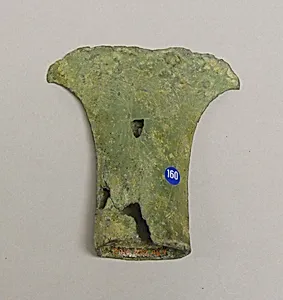
Hafted Ax
Unknown Artist
500 BCE–300 CE
Medium
Bronze
Dimensions
H. 3 9/16 in. (12.5 cm); W. 3 1/4 in. (8.6 cm)
Classification
Metalwork
Culture & Period
Indonesia · Bronze and Iron Age period
Department
Asian Art
Museum
Metropolitan Museum of Art, New York, NY
Credit
Samuel Eilenberg Collection, Bequest of Samuel Eilenberg, 1998
Accession Number
2001.433.464
Rights
Public Domain
Art Historical Context
This exquisite hafted ax, crafted from bronze during Indonesia's Bronze and Iron Age500 BCE–300 CE), exemplifies the metalworking skills of ancient Southeast Asian artisans. Measuring just 3 9/16 inches high 3 1/4 inches wide, compact form was designed for hafting onto a wooden handle, serving as both a practical tool and possible ceremonial object. The unknown creator's work highlights the from stone to metal tools, a pivotal technological leap in the region. Bronze, an alloy of copper and tin, was prized for its durability and ability to hold a sharp edge, reflecting advanced lost-wax casting techniques that allowed for intricate designs. In Indonesian cultures of this era, such axes were integral to daily life—used for clearing forests, warfare, or rituals—while their refined shapes suggest artistic intent, blending utility with symbolic power. Now part of the Metropolitan Museum of Art's Asian Art Department, this piece from the Samuel Eilenberg Collection (bequest, 1998) offers a window into prehistoric ingenuity. Imagine wielding it in lush island landscapes, a testament to human innovation and cultural resilience.