
Hagar and the Angel (Agar et l'ange)
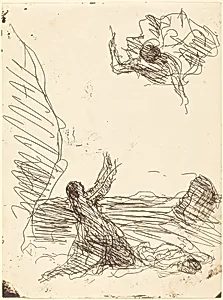
Medium
cliché-verre
Classification
Department
CG-E
Museum
National Gallery of Art, Washington, D.C.
Credit
Print Purchase Fund (Rosenwald Collection)
Accession Number
1967.18.28
Rights
Public Domain
Art Historical Context
In the serene yet dramatic *Hagar and the AngelAgar et l'ange)* of 1871, Jean-Camille Corot a pivotal biblical moment from Genesis: the outcast Hagar, fleeing into the desert with her son Ishmael, encounters a divine angel who promises solace and salvation. Corot, a of French landscape painting and a key figure in the Barb school, infused his late-career works with poetic light and subtle emotion, bridging Romanticism and the emerging Impressionist movement. This print reveals his softer, more introspective side, moving beyond his famed pastoral scenes. The artwork's medium, *cliché-verre*, marks its artistic innovation. This 19th-century hybrid technique involved drawing directly on a glass plate with ink or paint, then contact-printing it onto paper like an early photograph. Corot embraced it in his final years, producing a series of these ethereal biblical images that blend painterly freedom with photographic precision—offering rich tonal depth and a dreamlike glow unattainable in traditional etching. Housed in the National Gallery of Art's Rosenwald Collection (acquired via the Print Purchase Fund), this piece highlights Corot's experimental spirit at age 75, just four years before his death. It invites visitors to ponder the intersection of faith, exile, and artistic ingenuity, a timeless testament to human vulnerability illuminated by grace.
About the Artist
Jean-Baptiste-Camille Corot · 1796–1875
Jean-Baptiste-Camille Corot, born on July 16, 1796, in Paris to a prosperous bourgeois family—his father a former wig-maker turned draper and his mother a successful milliner—was initially apprenticed in the textile trade but pursued art from his mid-twenties with family support. He studied under the neoclassical landscapist Achille Etna Michallon in 1821–1822, who taught him to sketch outdoors in...