
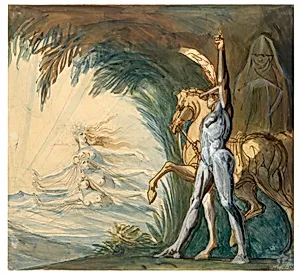
Hagen and the Nymphs of the Danube
Henry Fuseli, 1802
About this artwork
Henry Fuseli's *Hagen and the Ns of the Danube*1802) is a mesmerizing drawing that plunges viewers into a world of Germanic legend. The Swiss-born British artist, a key figure in Romanticism, drew inspiration from epic tales like the *Nibelungenlied*, the fierce warrior Hagen is linked to the Danube River—here evoked through ethereal nymphs and dynamic horses. Created late in Fuseli's career, this work captures his signature flair for the dramatic and supernatural, blending human intensity with mythical allure. Executed on cream wove paper with graphite, pen and brown ink, watercolor, and gouache, the piece measures a compact 12 5/16 x 13 1/4 inches. Fuseli's mixed-media technique allows for vivid contrasts: the fluid watercolor suggests watery nymphs, while precise ink lines define muscular forms and rearing horses, heightening tension and movement. This intimate scale invites close inspection, revealing his innovative approach to drawing as a standalone art form. Housed in the Metropolitan Museum of Art's Drawings and Prints department (purchase, Lila Acheson Wallace Gift, 1994), the work underscores Fuseli's enduring influence on Romantic art, bridging neoclassical precision with emotional fervor. It's a window into early 19th-century fascination with folklore, perfect for pondering the clash of mortal ambition and nature's enchantment.