
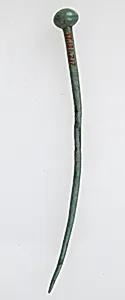
Hairpin
Unknown Artist
200–500
Medium
Copper alloy
Dimensions
Overall: 3 9/16 x 1/4 in. (9.1 x 0.7 cm)
Classification
Metalwork-Copper alloy
Culture
Roman
Department
Medieval Art
Museum
Metropolitan Museum of Art, New York, NY
Credit
Gift of J. Pierpont Morgan, 1917
Accession Number
17.191.217
Rights
Public Domain
Art Historical Context
This delicate copper alloy hairpin, dating from 200–500 AD, exemplifies everyday Roman craftsmanship during the Late Antique period. Measuring just 3 9/16 x 1/4 inches, its slender form was designed for practical yet elegant hair styling, a common accessory for women across the Roman Empire. Crafted from durable copper alloy—a widely used metal for its workability and corrosion resistance—this artifact highlights the technical skill of Roman metalworkers, who cast and possibly hammered such items to achieve both functionality and subtle refinement. In the context of Roman culture, hairpins like this one reveal intimate details of daily life, grooming rituals, and social norms. They were essential for securing elaborate hairstyles that signified status, marital status, or fashion trends, bridging the gap between the classical Roman world and the emerging medieval era. Though created by an unknown artisan, its preservation underscores the ubiquity of personal adornments in a society valuing both utility and aesthetics. Now housed in the Metropolitan Museum of Art's Medieval Art department as a gift from J. Pierpont Morgan in 1917, this hairpin offers visitors a tangible connection to ancient lives, reminding us how small objects illuminate broader histories.