
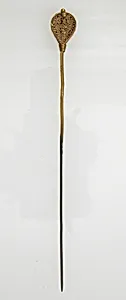
Hairpin
Unknown Artist
7th century
Medium
Gold
Dimensions
Overall: 5 1/16 x 7/16 x 3/16 in. (12.9 x 1.1 x 0.4 cm)
Classification
Metalwork-Gold
Culture
Frankish
Department
Medieval Art
Museum
Metropolitan Museum of Art, New York, NY
Credit
Gift of J. Pierpont Morgan, 1917
Accession Number
17.192.249
Rights
Public Domain
Art Historical Context
Step into the world of 7th-century Frankish with this exquisite gold hairpin, a delicate from the Metropolitan Museum of Art's Medieval Art collection. Measuring just over 5 inches long, this slender adornment—crafted from pure gold—likely served as both a practical hair fastener and a symbol of status for elite women in the Meroving Frankish kingdom. The Franks, a powerful Germanic people who dominated much of early medieval Europe under kings like Clovis and his successors, prized such personal luxury items, blending everyday utility with opulent display. As a prime example of Frankish metalwork, the hairpin showcases the era's masterful goldsmithing techniques, where artisans hammered and shaped the soft metal into precise, functional forms. Though simple in design, its survival speaks volumes about the durability of high-quality craftsmanship and the cultural importance of jewelry in signaling wealth and identity amid the turbulent transition from late antiquity to the Middle Ages. Gifts like this one, donated by J. Pierpont Morgan in 1917, offer us a tangible link to the lives of long-ago nobility. This unassuming yet radiant object reminds us how even intimate accessories reflected the artistry and social hierarchies of Frankish society, inviting you to imagine it glinting in the candlelight of a royal hall.