
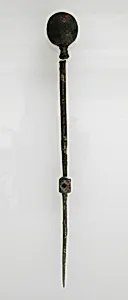
Hairpin
Unknown Artist
500–700
Medium
Bronze-gilt
Dimensions
Overall (a-c): 5 5/16 x 9/16 in. (13.5 x 1.5 cm) a knop only: 7/8 x 9/16 in. (2.2 x 1.5 cm) b part of a shaft only: 2 1/4 x 1/8 in. (5.7 x 0.3 cm) c lower part of a shaft only: 2 3/16 x 3/16 in. (5.6 x 0.5 cm)
Classification
Metalwork-Bronze
Culture
Frankish
Department
Medieval Art
Museum
Metropolitan Museum of Art, New York, NY
Credit
Gift of J. Pierpont Morgan, 1917
Accession Number
17.193.124a-c
Rights
Public Domain
Art Historical Context
This exquisite bronze-gilt hairpin, crafted by an unknown Frankish artisan between 500 and 700 CE, offers a glimpse into the daily elegance of early medieval Europe. Dating to the Merovingian period—the era of the Frankish kingdoms that laid the foundations of modern France and Germany—this slender adornment (measuring about 5 5/16 inches long when complete) was likely used to secure elaborate hairstyles, a mark of status and personal style among women of means. Its fragmented state—preserved as a decorative knop and two shaft sections—hints at the fragility of ancient artifacts unearthed from graves or settlements. The medium of bronze-gilt exemplifies skilled metalworking techniques of the time: bronze was cast for durability, then gilded with a thin layer of gold to mimic lavish luxury at a more accessible cost. This fire-gilding process, involving mercury and gold alloys heated to fuse the shine, highlights Frankish innovation in blending functionality with opulence. Such hairpins were not mere trinkets but cultural touchstones, often found in burials, symbolizing identity, wealth, and even spiritual beliefs in a turbulent post-Roman world. A generous gift to The Metropolitan Museum of Art from J. Pierpont Morgan in 1917, this piece invites us to imagine a Frankish noblewoman's morning routine, bridging the gap between ancient craftsmanship and our own fascination with history's intimate details.