
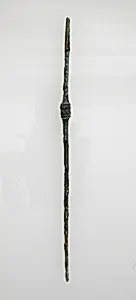
Hairpin
Unknown Artist
7th century
Medium
Bronze
Dimensions
Overall: 5 15/16 x 3/16 in. (15.1 x 0.5 cm)
Classification
Metalwork-Bronze
Culture
Frankish
Department
Medieval Art
Museum
Metropolitan Museum of Art, New York, NY
Credit
Gift of J. Pierpont Morgan, 1917
Accession Number
17.193.290
Rights
Public Domain
Art Historical Context
This delicate bronze hairpin, crafted by an unknown Frankish artisan in the 7th century, offers a glimpse into everyday elegance during the early Medieval period. Measuring just 5 15/16 x 3/16 inches (15.1 x 0.5 cm), its form suggests it was designed to secure hair, a practical yet ornamental accessory likely worn by women of status. The choice of bronze—a durable alloy of copper and tin—highlights the Franks' proficiency in metalworking, a skill inherited from Roman traditions and refined through local innovation. Originating from the Frankish culture, which dominated much of western Europe under the Merovingian dynasty (roughly 481–751 CE), this piece reflects a time of cultural transition after the fall of Rome. The Franks blended Germanic tribal aesthetics with Christian influences, and such personal items reveal insights into grooming, fashion, and social hierarchy. Bronze hairpins like this were common grave goods, underscoring their role in both life and afterlife rituals. Today, housed in the Metropolitan Museum of Art's Medieval Art department (gift of J. Pierpont Morgan, 1917), this unassuming artifact celebrates the artistry of anonymous makers. It reminds us that beauty often lay in the functional, inviting visitors to ponder the lives of those who once held it close.