
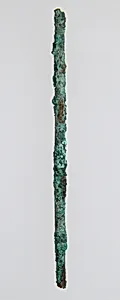
Hairpin Point
Unknown Artist
200–500
Medium
Copper alloy
Dimensions
Overall: 1 11/16 x 1/16 in. (4.3 x 0.2 cm)
Classification
Metalwork-Bronze
Culture
Roman
Department
Medieval Art
Museum
Metropolitan Museum of Art, New York, NY
Credit
Gift of J. Pierpont Morgan, 1917
Accession Number
17.191.51
Rights
Public Domain
Art Historical Context
This delicate "Hairpin Point" from the Roman world (ca. 200–500 CE) exemplifies the everyday elegance of Late Antique personal adornments. Crafted copper alloy—a durable and affordable material often likened to bronze—this slender artifact measures just 1 11/16 x 1/16 inches (4.3 x 0.2 cm), forming the finely tapered tip of a hairpin used to secure elaborate hairstyles. Donated to the Metropolitan Museum of Art in 1917 by J. Pierpont Morgan, it now resides the Medieval Art department, the classical Roman era and early medieval traditions. Roman metalworkers excelled in such small-scale metalwork, employing techniques like casting and cold-working to achieve a smooth, precise finish that balanced functionality with subtle sophistication. Hairpins like this were ubiquitous among women of various social classes, reflecting cultural norms around beauty, status, and grooming during the empire's waning centuries—a time of cultural fusion amid migrations and Christianization. Though created by an unknown artisan, this piece offers a tangible glimpse into intimate Roman life, reminding us how ordinary objects illuminate history's textures. Its survival underscores the resilience of Roman craftsmanship in an era of transition.