
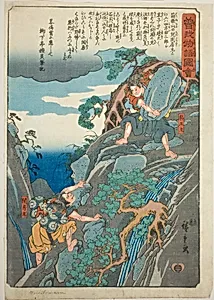
Hakoomaru (Soga no Goro), from the series "Illustrated Tale of the Soga Brothers (Soga monogatari zue)"
c. 1843/47
Medium
Color woodblock print; oban
Dimensions
35.2 × 24.7 cm (13 7/8 × 9 3/4 in.)
Classification
woodblock print
Department
Arts of Asia
Museum
Art Institute of Chicago
Accession Number
34454
Rights
Public Domain
Art Historical Context
Behold the dramatic woodblock print *Hakoomaru (Soga no Goro)* Utagawa Hiroshige's seriesIllustrated Tale of theoga Brothers (Soga monogatari zue)*, created around 1843–47. Hiroshige, a master the ukiyo-e, is renowned for his evocative landscapes, but here he captures the intensity of a legendary warrior from Japanese folklore. Rendered in the large oban format (35.2 × 24.7 cm), this color woodblock print exemplifies the vibrant, accessible art form that flourished in Edo-period Japan, bringing epic tales to everyday viewers. The Soga Brothers story, a cornerstone of kabuki theater and popular culture, recounts the brothers' quest for vengeance against their father's killer—a tale of loyalty, bravery, and tragedy that captivated 19th-century audiences. Hiroshige's depiction of Hakoomaru (Soga no Goro) likely emphasizes his fierce resolve, using bold lines and rich colors achieved through meticulous carving of multiple woodblocks, a technique that allowed for stunning tonal depth and mass production. Housed in the Art Institute of Chicago's Arts of Asia department, this print highlights ukiyo-e's role in democratizing art and storytelling. Visitors will appreciate its cultural resonance, evoking the thrill of yoshiwara plays and the enduring spirit of samurai honor. (198 words)
About the Artist
Utagawa Hiroshige · 1826–1869
Utagawa Hiroshige (1797–1858), born Andō Tokutarō, was the last great master of Japanese ukiyo-e woodblock printmaking and one of the most influential landscape artists in history. Born in Edo (modern Tokyo) into a low-ranking samurai family serving as fire wardens, Hiroshige transformed landscape printmaking into a poetic meditation on nature, weather, and everyday life. His revolutionary approac...