
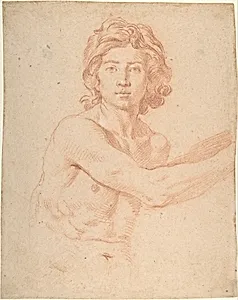
Half-Figure of a Youth with His Right Arm Raised
1612–48
Medium
Red chalk, a few white highlights, on beige paper
Dimensions
13 5/16 x 10 1/2in. (33.8 x 26.7cm)
Classification
Drawings
Department
Drawings and Prints
Museum
Metropolitan Museum of Art, New York, NY
Credit
Rogers Fund, 1969
Accession Number
69.1
Rights
Public Domain
Tags
Art Historical Context
In the intimate world of 17th-century Italian drawings, Simone Cantarini *Half-Figure of a Youth His Right Arm Raised* the Baroque era's fascination with dynamic human form. Born in Pesaro in 1612 and dying at 36, Cantarini was a leading figure in the Bolog school, trained under masters like Guido Reni. works blend classical elegance with emotional expressiveness, often serving as preparatory studies for paintings or engravings. This piece, created during his short but brilliant career (1612–48), depicts a young man in a poised, upward gesture—perhaps evoking youthful vigor or classical antiquity—rendered with fluid naturalism typical of life drawing sessions. Executed in red chalk with subtle white highlights on beige paper, the drawing exemplifies Cantarini's mastery of sanguine technique, a favored medium for its warm tones and ability to convey soft modeling and volume. At 13 5/16 x 10 1/2 inches, its modest scale invites close contemplation, revealing the artist's keen observation of anatomy and light. Housed in the Metropolitan Museum of Art's Drawings and Prints department (Rogers Fund, 1969), it highlights the Renaissance-to-Baroque transition in portrait studies, where such sketches bridged studio practice and finished portraits of men. This evocative youth reminds us of Cantarini's influence on later engravers and painters, offering visitors a window into the preparatory artistry that fueled grand canvases. A gem for those exploring Baroque draftsmanship!
About the Artist
Simone Cantarini · 1612–1648
He was one of the most eminent pupils of Guido Reni and one of the most gifted engravers in the tradition of the Carracci. He had a strong personality and developed a highly original style, which united aspects of Bolognese classicism with a bold naturalism. Comment on works: Religious