
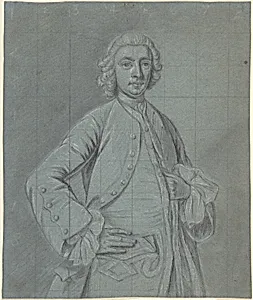
Half-Length Portrait Study of a Wigged Man
ca. 1740–60
Medium
Black and white chalk and graphite on blue laid paper, squared in graphite
Dimensions
sheet: 9 5/16 x 7 13/16 in. (23.6 x 19.9 cm)
Classification
Drawings
Department
Drawings and Prints
Museum
Metropolitan Museum of Art, New York, NY
Credit
Purchase, Jeffrey L. Berenson Gift, 2004
Accession Number
2004.514
Rights
Public Domain
Tags
Art Historical Context
Joseph van Aken's *Half-Length Portrait Study of a Wigged Man*, created around 1740–60, offers a captivating glimpse into 18th-century British portraiture. This preparatory drawing captures a gentleman in half-length pose, his elaborate powdered wig—a hallmark of the era's fashionable elite—framing a thoughtful expression. Van Aken, a Flemish-born artist active in England, renowned for his meticulous studies that supported larger oil portraits, blending Rococo elegance with English realism. Executed in black and white chalk with graphite on blue laid paper, the work showcases van Aken's mastery of mixed media. The blue paper provides a subtle mid-tone ground, allowing white chalk to pop as highlights on the wig and face, while dark chalk and graphite build rich shadows and contours. Graphite squaring grids reveal its practical purpose: transferring the composition accurately to canvas, a common technique among period artists ensuring precise scaling. Housed in the Metropolitan Museum of Art's Drawings and Prints department, this 9 5/16 x 7 13/16-inch sheet highlights the unsung role of studies in grand portrait traditions. It evokes the cultural world of Enlightenment-era sitters—merchants, nobles, or scholars—whose powdered wigs symbolized status and sophistication, inviting us to appreciate the artistry behind polished final works.