
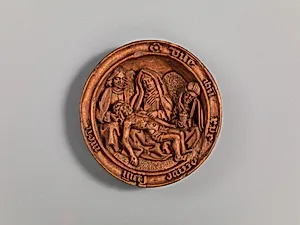
Half of a Prayer Bead with the Lamentation
Unknown Artist
early 16th century
Medium
Boxwood, silver
Dimensions
Diam. 1 3/16 × 1/4 in. (3 × 0.6 cm)
Classification
Sculpture-Miniature-Wood
Culture
Netherlandish
Department
Medieval Art
Museum
Metropolitan Museum of Art, New York, NY
Credit
Gift of J. Pierpont Morgan, 1917
Accession Number
17.190.458a, b
Rights
Public Domain
Tags
Art Historical Context
Nestled in the palm of your hand, this exquisite *Half of a Prayer Be with the Lamentation* reveals the masterful Netherlandish artistry of the early 16th century Carved from dense boxwood and accented with silver, it just 1 3/16 inches in diameter and a mere 1/4 inch thick—small enough to thread onto a rosary. Produced in the Northern Renaissance, these miniature sculptures, known as "prayer nuts" or beads, were devotional treasures for the pious elite, transforming everyday prayer objects into portals of profound spirituality. The scene captures the Lamentation, a poignant moment after Christ's crucifixion, featuring the Virgin Mary cradling her son, Mary Magdalene, and attendant saints in intimate sorrow. Boxwood's fine grain allowed carvers to achieve astonishing detail—drapery folds, expressive faces, and architectural backdrops—at a microscopic scale, rivaling the era's most skilled goldsmiths. This half likely paired with another to form a complete, spherical bead, opened for meditation on Christ's Passion. A gift to the Metropolitan Museum of Art from J. Pierpont Morgan in 1917, it exemplifies the anonymous genius of Netherlandish workshops, blending technical virtuosity with deep Catholic devotion. Gaze closely, and you'll marvel at how such tiny wood evoked eternal faith.