
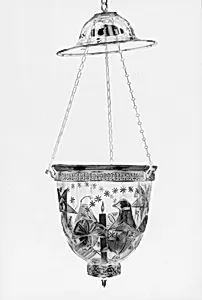
Hall Lantern
Unknown Artist
1815–25
Medium
Blown and cut glass, gilded brass
Dimensions
H. 12 1/2 in. (31.8 cm); Diam. 12 3/8 in. (31.4 cm)
Classification
Hall lantern
Culture
American
Department
The American Wing
Museum
Metropolitan Museum of Art, New York, NY
Credit
Friends of the American Wing Fund, 1979
Accession Number
1979.479
Rights
Public Domain
Tags
Art Historical Context
This elegant Hall Lantern, crafted in America between 1815 and 1825, exemplifies the refined decorative arts of the early Republic. Made from blown and cut glass combined with gilded brass, it about 12½ inches high and wide, perfect for illuminating grand entryways. The blown glass technique involved shaping molten glass by blowing air into it, while intricate cutting created sparkling facets that caught candlelight, enhancing its luminous beauty. Gilded brass added a touch of opulence, with gold leaf applied over the metal frame for a luxurious sheen. During this post-War of 1812 era, such lanterns were status symbols in prosperous American homes, blending functionality with neoclassical-inspired elegance. Hanging in hallways, they welcomed guests with soft, flickering light, often featuring motifs like birds—symbolizing freedom or nature in Federal and Empire styles. Though the artist remains unknown, the piece reflects skilled craftsmanship from glasshouses in New England or the Mid-Atlantic, where artisans drew from European traditions while asserting American ingenuity. Today, housed in The Metropolitan Museum of Art's American Wing (acquired through the Friends of the American Wing Fund in 1979), this lantern offers a glimpse into daily life and aspiration in 19th-century America, reminding us how light fixtures doubled as artistic statements.