
Hand Bell
Unknown Artist
ca. 11th–12th century
Medium
Bronze
Dimensions
H. 8 1/10 in. (20.6 cm)
Classification
Metalwork
Culture & Period
Indonesia (Java) · Eastern Javanese period
Department
Asian Art
Museum
Metropolitan Museum of Art, New York, NY
Credit
Samuel Eilenberg Collection, Gift of Samuel Eilenberg, 1987
Accession Number
1987.142.236
Rights
Public Domain
Tags
Art Historical Context
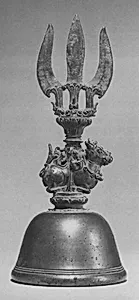
This exquisite bronze hand bell, dating to around the 11th–12th century from Java, Indonesia, stands as a testament to the Eastern Javanese period's of metalwork. Measuring just over 8 inches (20.6 cm) in height, it exemplifies the era's sophisticated bronze casting techniques, likely employing the lost-wax method to create intricate forms. Crafted by an unknown artisan, the bell served as a portable musical instrument, its resonant tone evoking the spiritual and ceremonial life of ancient Javanese society. In the vibrant Hindu-Buddhist kingdoms of eastern Java, such as those preceding the Singhasari dynasty, hand bells played key roles in rituals, temple ceremonies, and ensembles akin to early gamelan traditions. Adorned with animal motifs—symbolizing mythical guardians or natural forces—the bell blends functionality with artistry, reflecting Java's rich iconography where animals embodied power and cosmology. Its survival highlights the durability of bronze, a prized medium for both utilitarian objects and sacred icons. Today, this piece from the Samuel Eilenberg Collection graces the Metropolitan Museum of Art's Asian Art department, offering visitors a tangible link to medieval Indonesia's cultural splendor. Ring it in your imagination to hear echoes of ancient rites!