
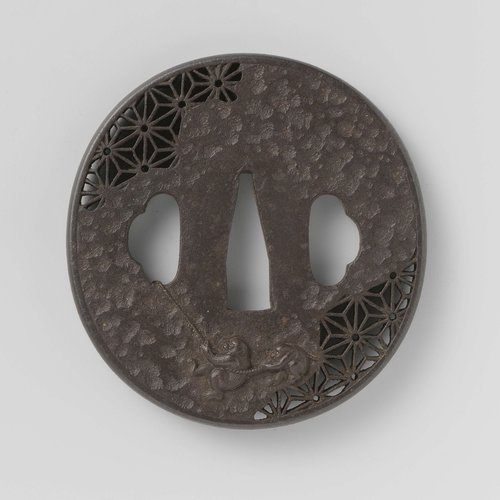
Hand guard
1800 - 1850
Medium
iron (metal)
Dimensions
7; 7.3
Rights
Public Domain
About this artwork
Bruikleen van de Koninklijke Vereniging van Vrienden der Aziatische Kunst (legaat Westendorp-Osieck, 1968)
Art Historical Context
This exquisite *Hand guard* (tsuba), crafted by the skilled Japanese artisan Mitsuhiro (II) between 1800 and1850, exemplifies the masterful metalwork of Japan's Edo period. Measuring just 7.3 cm high and 7 cm wide, this iron piece served as a protective guard on a samurai sword, separating the blade from the hilt to shield the wielder's hand during combat. Today, it stands as a loaned treasure (*bruikleen*) from the Konink Vereniging van Vrienden der Aziatische Kunst, via the Westendorp-Osieck legacy of 1968, highlighting its enduring cultural value. In the hierarchical world of samurai culture, tsuba were far more than functional; they were miniature canvases for artistic expression. Mitsuhiro (II), part of a lineage of renowned sword fittings makers, forged this guard from iron—a durable medium prized for its workability in creating openwork designs, subtle textures, and symbolic motifs. Edo-period artisans like him elevated *tosogu* (sword fittings) to high art, blending utility with poetic refinement. Though compact, this hand guard invites close inspection, revealing the precision of traditional Japanese metallurgy. It reflects the era's fascination with *wabi-sabi* aesthetics—embracing imperfection and transience—while underscoring the samurai's dual role as warrior and connoisseur. A perfect gem for contemplating Japan's artistic legacy!