
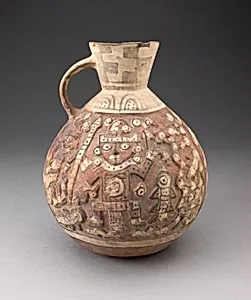
Handeled Jar with Painted Relief Depicting Figure with Animals
1000–1476
Medium
Ceramic and pigment
Dimensions
22.4 × 17.5 cm (8 13/16 × 6 7/8 in.)
Classification
earthenware
Department
Arts of the Americas
Museum
Art Institute of Chicago
Accession Number
91664
Rights
Public Domain
About this artwork
The subtly raised design on this ceramic jar depicts a warrior wearing a crescent headdress and holding a staff. This figure is surrounded by fish, a hawk-human hybrid, and a serpent, which create a dynamic scene that emphasizes the cultural importance of animals and their imagery.
Art Historical Context
This exquisite handled jar, crafted by artisans of the Lambayeque culture (also known as Sicán) in northern Peru between 1000 and 1476 CE, exemplifies the sophistication of pre-Columbian ceramics. Made from earthenware and adorned with pigments, the vessel measures 22.4 × 17.5 cm and is now housed in the Art Institute of Chicago's Arts of the Americas department. The Lambayeque people, who flourished along the coastal Lambayeque Valley before the rise of the Inca Empire, were master potters renowned for their intricate vessels that blended functionality with ritual symbolism. The jar's standout feature is its painted relief depicting a central figure surrounded by animals, a motif common in Lambayeque art that likely evokes shamanistic or mythological themes. Artisans achieved this dynamic effect through modeling clay for three-dimensional reliefs, then applying slips and pigments in bold colors—often reds, blacks, and creams—for vivid storytelling. Such techniques highlighted the culture's advanced knowledge of firing and post-firing decoration, transforming everyday forms into sacred objects used in ceremonies or elite burials. This artwork offers a window into Lambayeque society, where ceramics served as canvases for expressing cosmology, power, and harmony with nature. Its preservation reveals the enduring legacy of these innovators, bridging the gap between the earlier Moche tradition and later Chimú influences.