
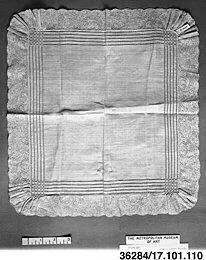
Handkerchief
Unknown Artist
17th–18th century
Medium
Bobbin lace
Dimensions
L. 14 x W. 14 inches (35.6 x 35.6 cm)
Classification
Textiles-Laces
Culture
Flemish
Department
European Sculpture and Decorative Arts
Museum
Metropolitan Museum of Art, New York, NY
Credit
Bequest of Laura Frances Hearn, 1917
Accession Number
17.101.110
Rights
Public Domain
Art Historical Context
This exquisite square handkerchief, crafted from bobbin lace by an unknown Flemish artist in the 17 or 18th century, measures a practical 14 by 14 inches, perfect for a gentleman's pocket or a lady's adornment. Housed in the Metropolitan Museum of Art's Department of European Sculpture and Decor Arts, it entered the collection through the generous bequest of Laura Frances Hearn in 1917. As a prime example of textiles-laces classification, it showcases the pinnacle of Flemish lace-making, a craft that turned fine linen threads into delicate, ornamental webs. Bobbin lace, a technique where threads are twisted and plaited around handheld bobbins over a patterned pillow, flourished in Flanders—today's Belgium—during this Golden Age of lace production. Centers like Brussels and Mechlin produced laces prized across Europe for their intricate motifs and airy transparency, symbolizing wealth and refinement. Worn by nobility and displayed in portraits by artists like Rubens, such handkerchiefs were not mere utilities but status symbols, blending functionality with artistry. Though the precise design remains understated in documentation, this piece embodies the technical mastery and cultural prestige of Flemish lacemakers, whose innovations influenced global fashion for centuries. A testament to anonymous skill, it invites us to appreciate the hidden labor behind everyday luxury.